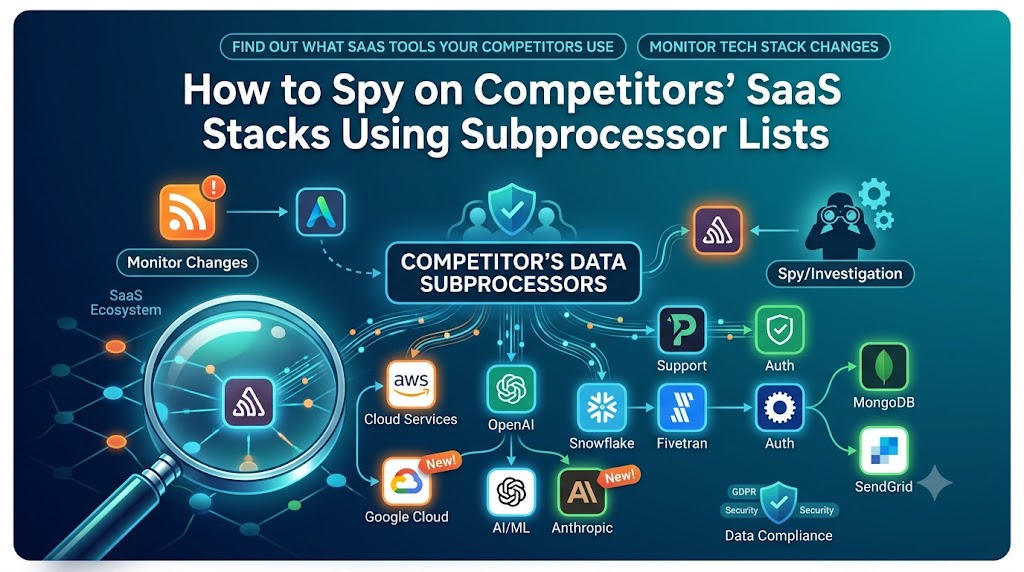
Want to know what SaaS stack a B2B company runs on? You don’t need a data leak or an insider - the company publishes it for you. Look at their sub-processor list.
Most B2B companies are contractually required to disclose every third-party vendor that touches customer data. These sub-processor pages are public, they’re kept up to date, and they quietly reveal a competitor’s entire tech stack: cloud provider, monitoring, customer support, AI/ML vendors, and more.
What is a sub-processor?
A sub-processor is any third-party service a company shares customer data with to run its product - think AWS for hosting, Datadog for monitoring, or OpenAI for AI features. Privacy regulations like the GDPR push companies to list these vendors publicly, which is exactly why sub-processor pages are a goldmine for competitive intelligence.
Let’s demonstrate this with a few live examples.
Sentry
Sentry’s sub-processor list shows that it uses AWS and Google Cloud for its deployments. Further, it uses OpenAI and Anthropic (and not Gemini) for AI/ML services.
OpenAI
OpenAI’s sub-processor list, among other things, shows that it uses Snowflake for data warehousing and Pylon Labs for customer support. Further, it uses Google, Oracle, Microsoft, and Amazon for cloud infrastructure.
Google’s sub-processor list shows that it uses Palo Alto Networks for intrusion detection and prevention.
Palo Alto Networks
Palo Alto Networks uses Cloudflare for DDoS protection, Datadog for monitoring, and SpyCloud for dark web searches. It appears to use Anthropic (but not OpenAI) for LLMs.
SpyCloud
SpyCloud uses AWS for hosting and Okta for identity management.
How to monitor a competitor’s SaaS stack over time
The real advantage isn’t a one-time snapshot - it’s the change log. By tracking a competitor’s sub-processor page and watching for updates, you can tell when they
- Add a new AI/ML vendor
- Switch cloud providers or add a second one for either a migration or reliability
- Bring on a new customer-support, analytics, or security tool
Sub-processor pages are usually versioned or dated, and many companies let you subscribe to change notifications. Bookmark the pages, diff them periodically, and you’ll spot shifts in your competitors’ tech stack before they announce anything publicly.
Key takeaway
Sub-processor lists are one of the most underrated sources of B2B competitive intelligence. They’re public, accurate, and continuously updated. By reading the sub-processors of your competitors - and monitoring the list for changes - you can map out exactly which SaaS tools they rely on and when they change their stack.