Notable quotes from "How to Live" by Derek Sivers

Notable quotes from "How to Live" by Derek Sivers

Some notable quotes from " How to Live" by Derek Sivers. It consists of 27 stories independent of each other. Some contradict ideas from others. And that’s what makes this short read even more provocative.

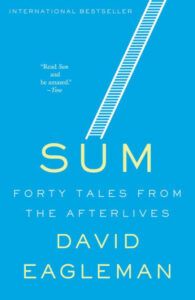
Book summary of Sum: Forty Tales From The Afterlives

Book summary of Sum: Forty Tales From The Afterlives

Sum: Forty Tales From The Afterlives is a collection of 40 short stories, describing what could happen in our afterlives. Here are my key takeaways from the book.

bed-of-procrustes

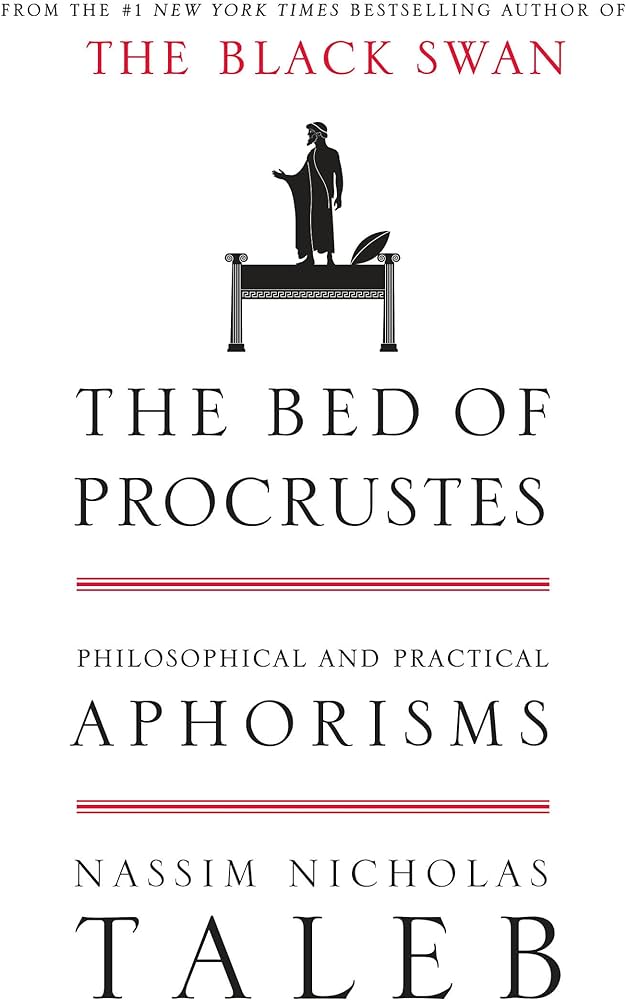
The Bed of Procrustes by Nassim Nicholas Taleb

The Bed of Procrustes is a short book consisting of quotes by Taleb. Unlike his other books, this book is mostly a collection of quotes. Procrustes used to stretch/amputate his guests who wouldn’t fit on his bed. Similarly, when our minds need to reduce information, we are more likely to try to squeeze a phenomenon into the Procrustean bed of a crisp and known category (amputating the unknown), rather than suspend categorization, and make it tangible. That’s the central theme of this book.

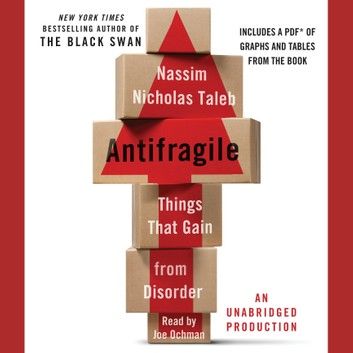
Book cover of "Antifragile: Things That Gain from Disorder" by Nassim Nicholas Taleb

Book summary: Antifragile by Nassim Nicolas Taleb

Another great read in the Incerto series by Taleb. The core idea is that certain systems benefit from uncertainty. And our goal should be to make all systems antifragile, so that, they can benefit from uncertainty.

Fooled by Randomness

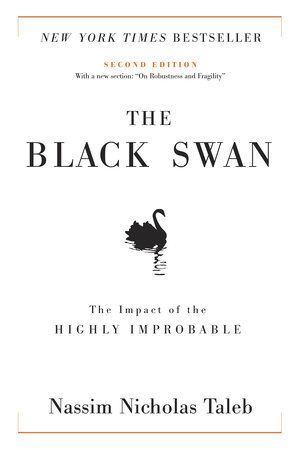
Book Summary: The Black Swan by Nassim Nicolas Taleb

The book posits a unique viewpoint to understand randomness and unpredictability in the world around us. Rather than trying to predict the improbable black swans, it focuses more on how not to be adversely impacted by them.

Skin in the game

Book summary: Skin in the game by Nassim Nicolas Taleb

Skin in the game Skin in the game creates a diversity of beliefs and ideas, for example, restaurant businesses. Lack of it creates a monoculture, for example, journalism. Skin in the game comes with a conflict of interest. For example, a shareholder is more inclined to say positive things about the company, whose shares he holds. Even then, skin in the game is preferable over no skin in the game. A lack of skin in the game, usually, produces a monoculture of beliefs. Bureaucrats, with no skin the game, usually make the problems worse by deciding things from the top. Beware of “good” advice where you will get both the good and the adverse outcomes of that advice while the advice-giver will only get a good result. Metrics puts one’s skin in the wrong game. For example, a doctor who has to optimize for a five-year survival rate of a cancer patient might go for radiation therapy as opposed to laser surgery even though radiation therapy has worse 20-year survival rates. Pilots have more skin in the game than surgeons. If a plane has a 98% chance of surviving a flight, then all pilots would have been dead for now, while medical science can operate with a much lower survival rate since skin in the game is primarily of the patients and much lower of surgeons. An academic experiment where one is supposed to wager a bet and hypothetically believe in a specific scenario is devoid of real risk and hence devoid of skin in the game. Academia, when left unchecked, for the lack of skin in the game, evolves into a ritualistic self-referential publishing game.

Random? or not?

Book summary: Fooled by Randomness by Nassim Nicholas Taleb

The book talks about randomness, associated maths, and the psychological biases which interfere with a more stochastic approach to thinking about life.

The Last Lecture by Randy Pausch

Book summary: The Last Lecture by Randy Pausch

Some salient notes from the book If there’s an elephant in the room, introduce it. Even if you are in the position of strength, be fair. Have something to bring to the table, people would be more welcoming of you to join in then. Get the fundamentals right, fancy stuff does not work without that. When you are screwing up and nobody says anything, they have given up on you (that’s a really bad place to be). Playing sports is not about learning the technicalities of the game but about teamwork, perseverance, sportsmanship, the value of hard work and ability to deal with adversity. The brick walls are there for a reason. They are not there to keep us out, they are there to give us a chance to show how badly we want something. Manage time explicitly like money You can always change your plan, but only if you have one. Ask yourself: are you spending your time on the right things Delegate your work as much as possible What’s more fun than fulfilling one’s own dreams is to help someone else fulfill their dreams. Use positive language, “When does this [Disney] park close?” is to be responded with “This park is open until 8 PM”. Don’t complain about your problems, whining does not help, focus on working harder instead. Almost everyone has a good side, if you wait long enough, it will come out. Focus on what people do not what they say. Experience is what you get when you didn’t get what you wanted. You can be an optimist if you have a contingency plan for what to do when all hell breaks loose. A bad apology is worse than no apology. No job is beneath you, do your best at whatever job you are put to. Rights come with responsibilities. If you lead your life the right way, the karma will take care of itself. The dreams will come to you.

The Power of Less

Book Summary: The Power of Less by Leo Babuta

The book contains pragmatic advice for dealing with the clutter and noise of the everyday world, which disguises itself in the form of work. The book has two parts. First one focuses on the principles and the second one provides concrete practical advice based on the same.

Difficulty of being good: Subtle art of Dharma

Summary: "Difficulty of being good: Subtle art of Dharma"

The book interprets events in the Mahabharata while trying to draw parallels from the contemporary world. The following are the key takeaways based on my understanding of the book. I am assuming some familiarity with the story of the Mahabharata.