Gadar Memorial

A visit to Gadar Memorial in San Francisco

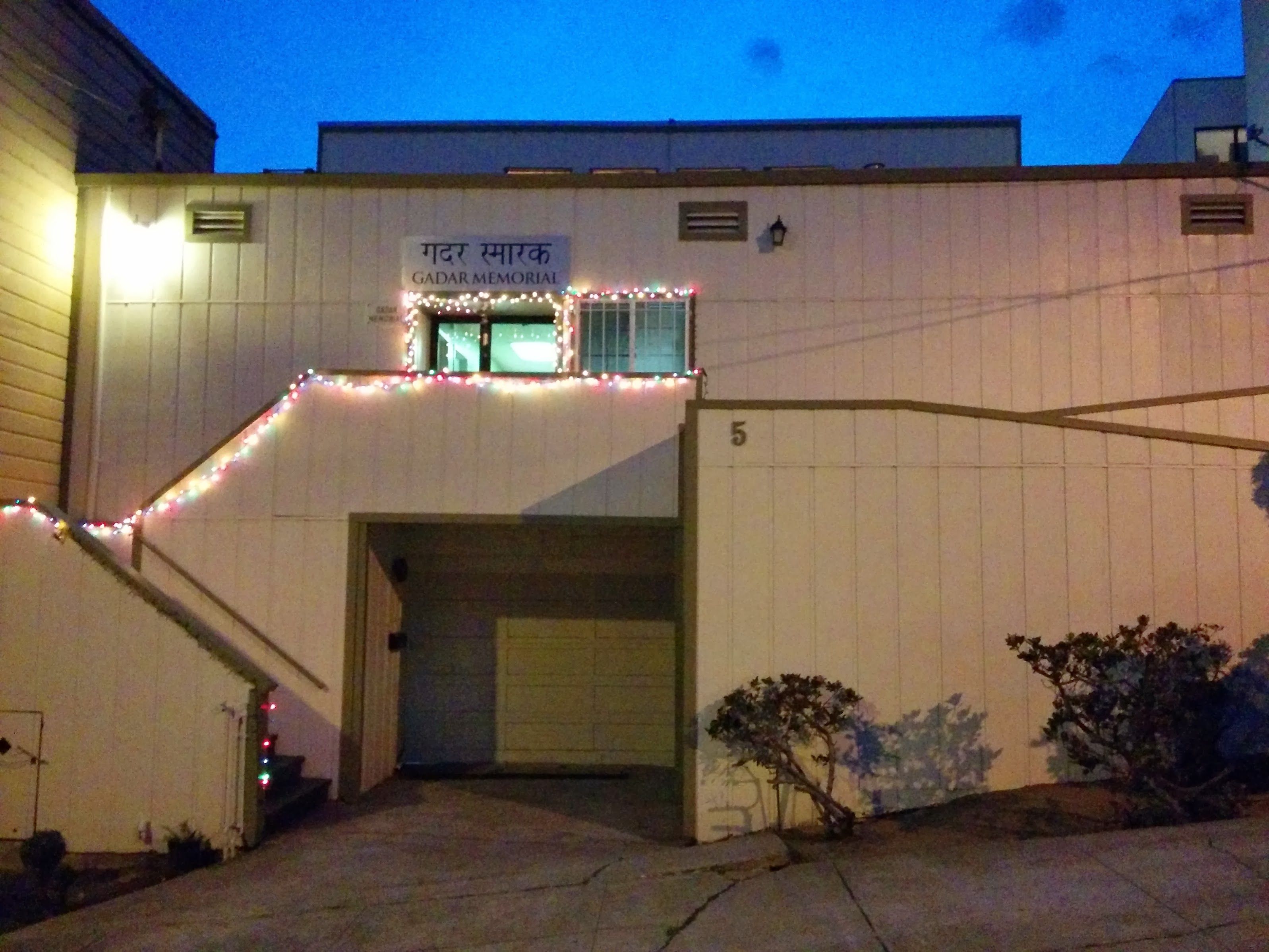
Getting Inside After getting misdirected once to 436 Hill St, San Francisco which is the old original address which does not exist anymore, I eventually reached 5 Wood St, San Francisco. It was the time of sunset, I knew I was late, but finally, it felt good to see a nondescript apartment marked “Gadar memorial”. Least, I expected locked doors. I did not drive 40 miles to stand in front of this locked door. There must be a way to get in, I contemplated, as I noticed an Indian woman walking upstairs towards me. “I am here to see Gadar Party’s office”, I asked as she stammered while replying in English. “हिंदी बोलती है आप ?”, I inquired. “जी हाँ”, she confirmed. “मैं आशीष, south bay से आया हूँ ग़दर स्मारक देखना था । “, I said, while pointing towards the building. “आपके पास consulate से permission है?”, she asked. “consulate से permission?”, I inquired. “consulate से बिना permission लिए यहाँ आना मना है । “, she confirmed. Even for bureaucratic Indian govt, taking permission from the consulate to visit a first world war era memorial is perplexing. I believe this is the only such Indian memorial in the western hemisphere. Of course, I was not ready to yield and drive back another 40 miles before paying the homage. We both stood there motionless with an awkward silence. Someone had to blink, thankfully, she did. “एक बार मैं अपने husband से बात करती हूँ । “, she said. She unlocked the door and went inside, and after some chatter, they both came out, and after some quick conversation, he allowed me in to visit the memorial. The rest of the discussion with them was pretty friendly. ...

Thoughts on Bureaucrats, Technocrats and Politicians

Bureaucrats take the actions which are justifiable (by book or by order of their superiors), they care less about consequences (in case there are multiple possible actions, they let the politician decide the appropriate action). Technocrats take the actions which (according to their analysis) have best (long term/short term) consequences, they care less about how harsh the action could be on certain individuals and their logical thinking usually fails to take into account the law of unintended consequences like Cobra Effect. ...

Beyond Numbers: Dealing with terrorism in India

Let’s start with a small exercise. Trying searching for the list of Sept 2011 victims or for the list of London Bombing victims. In each case, more than half of the results on the first page lead to a list of names along with the photos and life stories of those people. Now, trying searching for the list of Hyderabad blast 2013 victims, you would get a few results like this which lists the names of the people but where are their photos and life stories? ...

Random Thoughts: Rape and The Indian Blame Game

After the Delhi gang-rape case, there has been a sudden upsurge in traditional as well as social media over rape in India. As usual in such cases, the initial reaction is to find someone to blame. And in this case, the onus of the blame has been put on Patriarchal Indian Society - without realizing that more rapes happen in the not-so-patriarchal USA Indian masculinity - “who feel threatened by women asserting their identity” without realizing that rapes happen even with infants, senior citizens, visually challenged, mentally challenged and homely women in conservative villages of Haryana to Kerala. Indian Police - as if police officials are omniscient and should be present before the crime happens Honey Singh - I am expecting a petition against Vatsyayana next This blog post is a collection of thoughts about the same. ...

Breakout Nations

Book Summary: Breakout Nations by Ruchir Sharma

The book provides a nice summary of economic events of the recent past (~50 years) and builds upon the case for the coming 10 years.

Female Foeticide

The first episode of Aamir Khan’s show Satyamev jayate raised the issue of female foeticide in Rajasthan. While the show asked for stringent laws, it missed a few major reasons behind the same.

Imagining India

Book Summary: Imagining India by Nandan Nilekani

The book presents a generalists view of post-independent India. Unlike “India Unbound”, this book focuses primarily on post-independent India and takes a more pragmatic approach towards understanding the problems of contemporary India. The best parts of the book are the interesting contradictions that the nation went through - love/hate relationship with the English language, fear of technology, and neglected urban development.

Towards a broken future of Internet

Internet, which initially started as a DARPA experiment is [still] under the indirect control of USA government through ICANN despite several objections from Europe as well as IBSA. This worked when most users were from the western world with the notable exception of China and few minor quirks. But in the past few decades, not only the governments around the world are putting more controls but also the internet users (as well as enterprises) are fighting back against US control. In this blog post, I will describe the main threats to the existence of (current form of) Internet.

Questioning Aakash - Indian Government tablet initiative

This blog post is not about how good or bad the product technically is or how indigenous it is; it’s about a fundamental problem with tablets. It amazes me to see that even a journalist like T. Friedman missed it. Anyone who had ever used a tablet will tell you that even the best of the current-generation tablets are for consumption and not content generation.

Understanding Corruption: A talk by Subramanian Swamy

(Following are a few notes from the talk on corruption by Harvard Professor and Janata Party leader, Dr. Subramanian Swamy held in bay area on July 29th 2011) Corruption - misuse of public office for personal gains Five impacts of corruption **