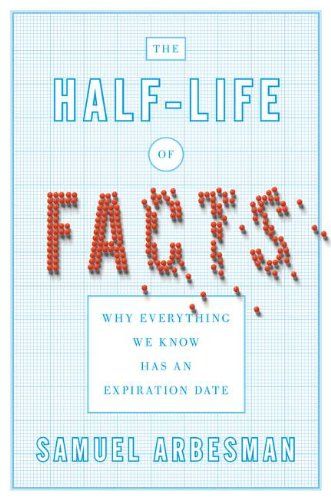
Half-life of Facts

Book Summary: The half-life of Facts by Samuel Arbesman

The Half-Life of Facts is a provocative book that makes us realize that a lot of facts that we believe are factually true get overturned over time. It gives several examples of facts that were later proven wrong or became more precise as our measurements and understanding improved.

Book cover of "Antifragile: Things That Gain from Disorder" by Nassim Nicholas Taleb

Book summary: Antifragile by Nassim Nicolas Taleb

Another great read in the Incerto series by Taleb. The core idea is that certain systems benefit from uncertainty. And our goal should be to make all systems antifragile, so that, they can benefit from uncertainty.

Fooled by Randomness

Book Summary: The Black Swan by Nassim Nicolas Taleb

The book posits a unique viewpoint to understand randomness and unpredictability in the world around us. Rather than trying to predict the improbable black swans, it focuses more on how not to be adversely impacted by them.

Skin in the game

Book summary: Skin in the game by Nassim Nicolas Taleb

Skin in the game Skin in the game creates a diversity of beliefs and ideas, for example, restaurant businesses. Lack of it creates a monoculture, for example, journalism. Skin in the game comes with a conflict of interest. For example, a shareholder is more inclined to say positive things about the company, whose shares he holds. Even then, skin in the game is preferable over no skin in the game. A lack of skin in the game, usually, produces a monoculture of beliefs. Bureaucrats, with no skin the game, usually make the problems worse by deciding things from the top. Beware of “good” advice where you will get both the good and the adverse outcomes of that advice while the advice-giver will only get a good result. Metrics puts one’s skin in the wrong game. For example, a doctor who has to optimize for a five-year survival rate of a cancer patient might go for radiation therapy as opposed to laser surgery even though radiation therapy has worse 20-year survival rates. Pilots have more skin in the game than surgeons. If a plane has a 98% chance of surviving a flight, then all pilots would have been dead for now, while medical science can operate with a much lower survival rate since skin in the game is primarily of the patients and much lower of surgeons. An academic experiment where one is supposed to wager a bet and hypothetically believe in a specific scenario is devoid of real risk and hence devoid of skin in the game. Academia, when left unchecked, for the lack of skin in the game, evolves into a ritualistic self-referential publishing game.

How not to be wrong

Book summary: How not to be wrong by Jordan Ellenberg

The book focuses on the application of simple and profound maths to day-to-day life and how not to be deceived by mathematical traps.

Random? or not?

Book summary: Fooled by Randomness by Nassim Nicholas Taleb

The book talks about randomness, associated maths, and the psychological biases which interfere with a more stochastic approach to thinking about life.

Where good ideas come from

Book summary: "Where good ideas come from" by Steven Johnson

The book presents a robust theoretical framework around how good ideas emerged in human history and debunking myths associated with the same. The underlying theme of the book is how coral reefs, big cities, and the worldwide web provide the right platform for innovation. The right platform for innovation provides liquid networks that encourage rapid information sharing, serendipitous encounters, the formation of slow hunches, the exploration of the adjacent possible, and the exaptation of existing solutions for solving seemingly unrelated problems.

What got you here won't get you there by Marshall Goldsmith

What got you here won't get you there by Marshall Goldsmith

The book presents Goldsmith’s experience on what causes the most talented, ambitious, and successful professional to hit a career roadblock. Almost all the professionals which Goldsmith worked with had interpersonal issues of one form of the other which either didn’t matter in the early phases of their career or the professionals were so talented that they progressed despite those issues. Put a comma in the wrong place and the whole sentence is screwed up. ...

Great By Choice by Jim Collins

Book summary: Great By Choice by Jim Collins

The book compares a set of 10 pairs of companies over a timeframe of over 20 years to demonstrate what choices the same companies make to become great. The great ones (10Xers) were not led by visionaries, they were not more innovative, they did not try to move too fast, and they were not luckier ones either.

So good they can't ignore you by Cal Newport

Book Summary: So good they can't ignore you by Cal Newport

The book is an excellent collection of rules which the author discovered while finishing his Ph.D. and transitioning into a full-time faculty position.