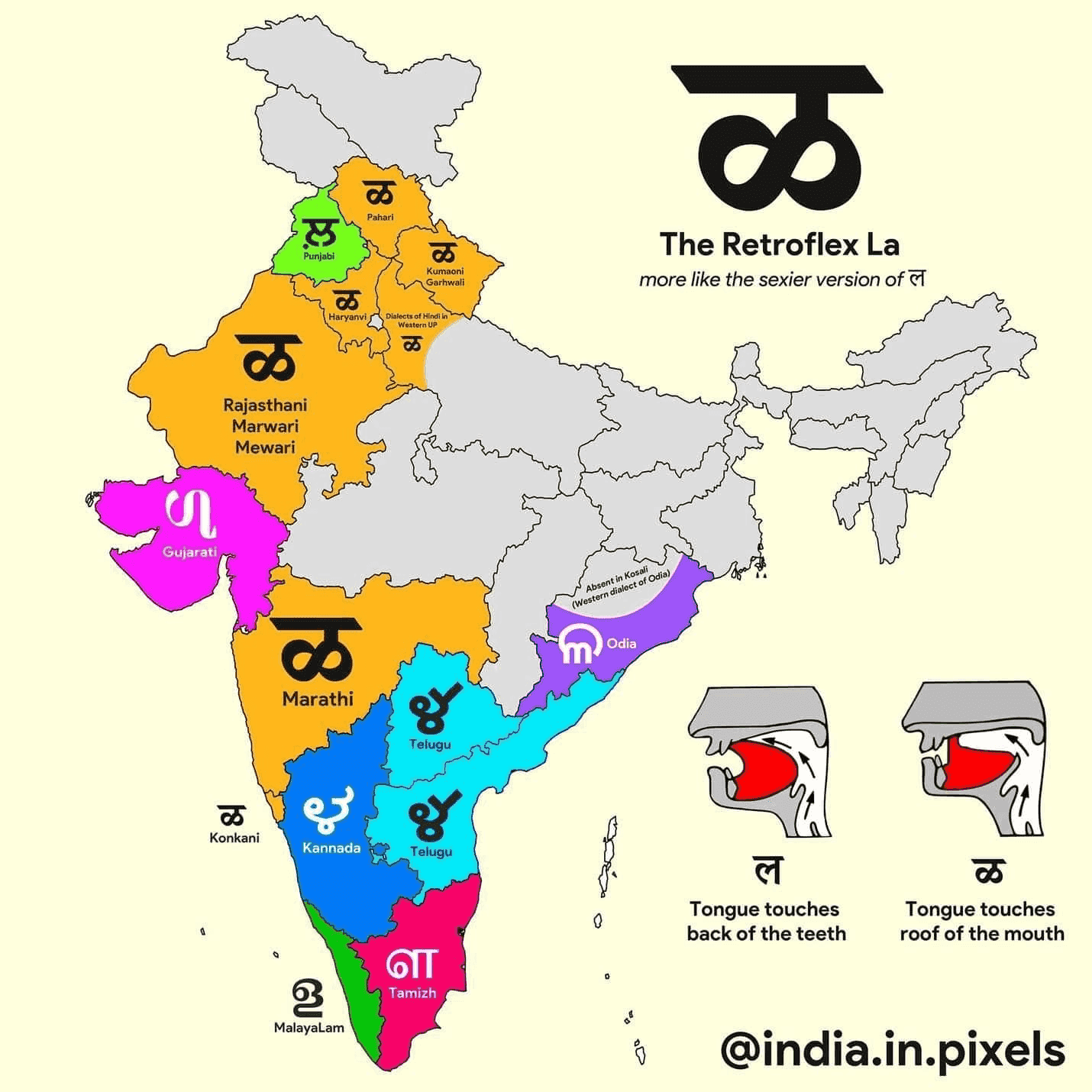
The sound ळ is a retroflex L/ल.
- Garhwali has this sound
- Haryanvi has it
- Punjabi has it
- Rajasthani dialects have it
- Marathi has it
- Tamil has it; in fact, it is the last sound in the name of the language itself. 1
- Malayalam has it. In fact, in the name of the language, the first
lis alveolar, but the secondlis retroflex (मलयाळम)
Even Vedic Sanskrit recognizes this sound. So, why is this sound missing from modern Hindi? Well, probably because this sound isn’t used in the Delhi-Meerut dialect that became the standard dialect of Hindi.
It is in the same category of retroflex sounds, which are relatively unique to Indic languages (ण, ष, ढ, ड़, ढ़).
Except it isn’t part of modern Hindi, so speakers don’t use this sound.
Unless, of course, they are speaking in one of the dialects like Haryanvi.
Some languages, like Tamil, transliterate ळ as zh.
Many Hindi newspapers
incorrectly transliterate this back as झ!
A perfect example of that is Kozhikode, which is incorrectly transliterated as कोझिकोड,
while the correct transliteration is कोळिकोड.
Similarly, the phonetically correct articulations are तमिळ and मल्याळम.
Strict Tamil speakers would point out that the name is
तमिऴ(tongue curl backwards but not touching the roof) and notतमिळ(tongue curl backwards and touching the roof). Well, that difference, unfortunately, is as subtle asvvswin English, and really requires retraining one’s ear to be able to hear the difference. ↩︎